

Organic Compost and Rooftop Farms
Our partner FoodCycle+ turns food waste from local food factories and shops into an organic compost, MixO Plus. The feedstock is herbal-tea dregs, spent grain, coffee grounds and okara, composted aerobically. The compost goes into rooftop farms, gardening and landscaping. Vegetables grown on the roof can go to hotel and restaurant kitchens.
Where the feedstock comes from
All feedstock is commercial and industrial food waste:
-
Herbal-tea dregs: the herbs left after brewing at herbal-tea shops and factories
-
Spent grain: malt left over from brewing
-
Coffee grounds: from coffee shops and office machines
-
Okara: the pulp left after soy-milk and tofu production
About 5% wood chips or spent mushroom substrate is added on top of the four food wastes.
Theoretical ratio:
Herbal-tea dregs 38%
Spent grain 28.5%
Coffee grounds 19%
Okara 9.5%
Wood chips or spent mushroom substrate 5%
Each actual batch varies a little with what comes in that period.


How it is made
-
Collection: Shops empty coffee grounds into 120-litre recycling bins. An electric truck collects them on scheduled days, roughly every two weeks.
-
Weighing: Every load is weighed and recorded.
-
Mixing: The four food wastes are mixed at the ratio above, with wood chips or spent mushroom substrate added.
-
Aerobic composting: The pile heats up and enters a high-temperature phase, which kills pathogens and weed seeds. The temperature then drops and the compost matures.
-
Packing: Finished compost is packed by end use.
Coffee grounds that cannot be processed in a given period go to an anaerobic digestion facility for food waste, where they produce biogas for electricity.

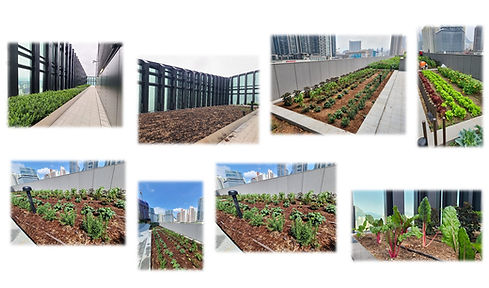

Rooftop farms
The rooftop farm service covers:
-
Farm setup: installing planting beds on the roof and starting the first planting
-
Educational workshops and farm visits
-
Staff and community planting sessions, including training participants as farming assistants
-
Harvest events
Our partner's rooftop farms have included mall rooftops, hotel rooftops, office rooftops, residential podium farms and schools.
Common crops are leafy greens such as lettuce, cabbage and rainbow chard, along with herbs, corn and sunflowers. School and community sessions have grown watermelon and rice.
Coffee grounds from mall coffee shops are collected and composted, and the compost goes back into the rooftop beds. The vegetables are used by hotel chefs and restaurants.
Activities by site type
-
Mall rooftops: Staff and participants tend the beds themselves. Chefs cook with the harvest. After harvest, the vegetables are bundled and sold alongside pot plants at a market stall in the mall. One programme trained farming assistants, and those who completed it received certificates. There are also children's planting workshops.
-
Hotel rooftops: Chef teams plant herbs and vegetables themselves, and a lunch has been served using locally grown produce.
-
Schools: Students raise seedlings in trays, then harvest and cook what they grow. Crops have included watermelon and aubergine.
-
Community events: Children plant rice in pots, then make crafts from the grain.
-
Residential podium farms: Planting beds are set up on the podium for corn and leafy greens.
-
Office rooftops: Vegetable beds are set up on the roof for lettuce and other leafy greens.


Workshops
Workshops on offer for offices and malls include mini pot plants, desk plants, window-sill herbs and succulent pots, using MixO Plus as the growing medium. A pop-up stall in a mall has also let customers design their own pots and plant them with the compost.
Talks cover how coffee-ground recycling fits a company's sustainability strategy, and the difference between compost and fertiliser.
Our partner also runs neighbourhood farming teams for young people and recently retired older people.
Environmental and ESG benefits
Environmental (E)
-
Food waste kept out of landfill: From January to June 2024, the reference project put 94,447 kg of feedstock, including wood chips or spent mushroom substrate, into composting. The 16,256 kg of coffee grounds collected from the malls over the same period all went to composting. Food waste in landfill breaks down and releases greenhouse gases; composting it avoids that.
-
Better soil: Compost raises soil organic matter and improves soil structure and fertility. The soil holds water and nutrients better, drains better and erodes less. Compost also helps suppress plant diseases and pests.
-
Soil biodiversity: Compost raises soil microbial activity and increases the variety and number of soil organisms.
-
Less chemical fertiliser: Heavy use of chemical fertiliser degrades soil and pollutes water. Compost adds organic matter and can cut the amount of chemical fertiliser used. Compost and fertiliser do different jobs, and the two can be used together.
-
A local loop with short transport: The feedstock is local, the compost is made locally, and it goes back into local rooftop farms, farms and greening. Coffee grounds are collected roughly every two weeks by electric truck.
-
Urban greening: Rooftop beds and planters add green space to the city, and the flowers and crops add to urban biodiversity.
Social (S)
-
Staff and tenant engagement: Staff and tenants can grow and harvest vegetables near where they work, and join pot-plant workshops.
-
School and community education: Through raising seedlings, planting rice, harvesting and cooking, students and children see how food is grown.
-
Local food: Seasonal vegetables from rooftops and local farms go to hotels, restaurants and markets, completing the loop from food-waste collection to the table.
Governance (G)
-
Traceable data: Every collection is weighed, and amounts are recorded by site and compiled into regular reports. Companies can use these figures in their sustainability reports.
-
A clear record of where it went: The reports state how much coffee ground was collected, how much went to composting and how much went to other facilities.


Who it suits
It suits malls, hotels and office buildings with coffee shops or food and beverage tenants, as well as residential estates and schools.
The site handles
-
Separating coffee grounds into 120-litre recycling bins
-
Arranging for staff, tenants, residents or students to take part
-
Providing roof or podium space (if a farm is set up)
We handles
-
Collection by electric truck or normal truck on scheduled days
-
Composting the grounds with other food waste to produce MixO Plus
-
Setting up rooftop farms and running workshops, tours and farming-assistant training
Reference project: coffee-ground collection at shopping malls
From January to June 2024, a group of shopping malls separated coffee grounds from their coffee shops, and our partner FoodCycle+ composted them. The grounds were composted together with herbal-tea dregs, spent grain, okara and wood chips or spent mushroom substrate.
Feedstock Input (kg) Actual ratio
Herbal-tea dregs 35,383 37.46%
Spent grain 26,627 28.19%
Coffee grounds 16,256 17.21%
Okara 10,277 10.88%
Wood chips or spent mushroom substrate 5,904 6.25%
Total 94,447 100%
This input produced 18,889 kg of MixO Plus, about one fifth of the input weight.

